The Laney Garden has gone through drastic changes over the last 20 years
Oakland – The garden at Laney College sits along the estuary, overflowing with edible crops. The garden is also packed with nearly 20 years of unique history and fond memories for its community.
Today, many resettled immigrant communities from Nepal, Bhutan, and Cambodia use the land to cultivate vegetables for their native dishes. Spanish garlic, onions, pumpkins, chayote, sweet potatoes, potatoes, tomatoes, squash, cucumbers, chili peppers and cilantro all grow in the Laney College community garden.
The garden is currently operated by the Oakland Community Land Trust (OCLT), a non-profit organization that buys housing, land, and properties in Oakland to preserve and develop Black, Latine, and Asian communities.
 Photo: Ariunzayat Yunren
Laney gardener Bahadur Rai watering vegetables at the Laney Community Garden at Laney College in Oakland, CA on Oct. 1, 2025.
The Peralta Community College District agreed to a three-year license with the land trust for them to operate and maintain the Laney College garden for hands-on learning, community building, and food production, under specific terms such as “maintaining the fence, keeping the area clean, […] and [gardeners] carry[ing] insurance” at its Nov. 18 board of trustees meeting.
This agreement connects the garden’s international communities and under-used land in Oakland.
The land trust is set to offer organizational support “to support the gardeners within the partnership with Laney,” according to Executive Director Steve King.
King told The Citizen that the land trust hopes for a longer partnership with the college,“to rebuild the entire fence at the garden in partnership with Laney’s carpentry and Japanese joinery students.”

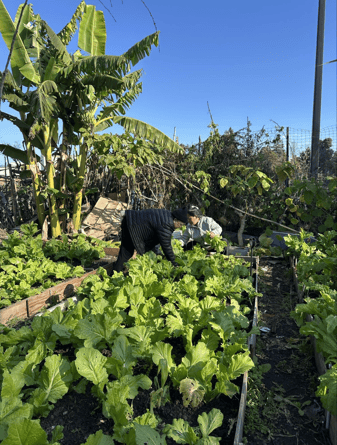
Photo: Ariunzayat Yunren
A gate that reads "you are loved" at the Laney Community Garden on Oct. 1, 2025.
The Roots of the Garden
The Laney community garden was built between the estuary and the Laney Bistro in 2008. Initially, the garden was built for culinary students to grow and harvest their own produce. Gradually, it changed throughout the years, later serving as a dual space; half for students with the Mindful Garden Collective, and the other half for a sprawling immigrant community.
In 2012, Laney College donated a plot of its garden to the International Rescue Committee’s (IRC) New Roots food and agricultural project, calling it the “Laney Community Partnership Garden.” The International Rescue Committee was formed in 1933, initially composed of a group of humanitarians including Albert Einstein, to focus support for refugees, immigrants, and other people escaping humanitarian crises.
The New Roots Project has used the entire garden space since the Mindful Garden Collective became defunct in 2015.
The Oakland based New Roots Project engaged “refugees, immigrants and their communities in urban agriculture, food markets, youth programs, community food orientation, and emergency food distribution.”
Gardener Man Mapchan, from Bhutan, told The Citizen, “Laney College gave us the land, the New Roots built the fence. Working in the garden is so entertaining.” He and his wife, Anu Mapchan, frequently visit the garden.
According to Zack Reidman, former program coordinator, The New Roots project lost its funding during the COVID-19 pandemic.
“This is partly why Laney College was interested in ensuring that the garden continues to thrive [and] to update the land use agreement between [Laney and Oakland Community Land Trust].” Reidman said.
New Growth
Becky Opsata, Interim President at Laney College and creator of the agreement with the land trust said that, prior to the agreement with Oakland Community Land Trust, “[Laney] didn’t have anything on paper, no agreement between the gardeners and Laney College.”
According to Opsata, the gardeners kept returning to the garden after the New Roots project ended.
Lila Dewan, a Nepali gardener, told The Citizen that there are nine Nepali families that farm on one side of the garden, while Cambodian families work on the other side.
For Anu Mapchan, the garden carries deeper meaning as she used to visit the garden with her late mother. Now, the garden serves as a place for meditation and remembrance.
“It’s so nice here,” Anu Mapchan said, “when I am working, I forget everything. It’s a good relaxing place, it’s [a] kind of meditation.”
Anu Mapchan said her mother died last year. She said that the garden helps her remember all of their “good time[s] together.”
Following the approval of the use of land, the Laney garden is a place for immigrants and the Peralta community to continue to grow together.